


Peru Through My Eyes : The Magic of Cusco and the Beginning of Salkantay Trek
Do you ever feel an unexplainable pull the moment you land in a new city?
It’s more than simply liking a place and saying, “I think I could live here.” It’s something deeper. As if the city is quietly calling you in a way no other place ever has. A feeling that’s impossible to explain, yet impossible to ignore. That’s exactly how Cusco felt to me.
The moment I stepped off the plane and walked out of the airport, I was completely enchanted. The city looked as though it had been lifted straight from the pages of a fairytale. Mountains embraced every side of the valley, their slopes dotted with homes that seemed to climb endlessly toward the sky. I had never seen anything like it.

The Capital of the Inca Empire
I have so much to say about Cusco. When I finally sat down in front of my laptop to write this, I wasn’t staring at a blank page because I had nothing to say. It was the opposite. I had so many emotions, memories, and feelings tangled together that I couldn’t find words big enough to describe this city. I typed a few sentences, deleted them, and started over more times than I can count. Every time I think about Cusco, my heart feels incredibly full. There is something about this city that keeps drawing me back. I can’t get enough of its streets, its people, its history, or its energy. In fact, I went back four different times, which probably says everything you need to know.
As I rode from the airport to my hotel, I kept my head out the taxi window, trying to absorb every little detail. I wanted to see everything, feel everything, and lose myself in the rhythm of the city. Yes, there were plenty of tourists. But somehow, Cusco never felt overrun by them. Its culture and history hadn’t been swallowed by tourism. Instead, visitors simply became part of the city’s daily life. We were walking alongside centuries of history, surrounded by ancient stone walls while modern life unfolded around us. Every street felt like it held a thousand untold stories.


When I arrived at my hotel, the magic continued. Even the building itself looked as though it had stood there for hundreds of years, quietly witnessing generations come and go. I wandered through the town, letting its magic pull me in a little more with every step. The centuries-old buildings, the cobblestone streets, the market vendors, the locals—everything fascinated me. I found myself slowing down, observing every little detail and trying to preserve it in my memory.
Sometimes, while traveling, I catch myself thinking far into the future. One day, when I’m old and grey, I’ll be sitting in a rocking chair with my grandchildren, telling them about this magical place I visited when I was young, curious, and chasing the world.
The sunset over Plaza de Armas was unlike anything I had ever seen. The sky slowly transformed into shades of gold, pink, and deep orange, casting a warm glow over the historic buildings. I spent hours people-watching, wandering without a destination, and memorizing every narrow alley I walked through, hoping I would never forget them.

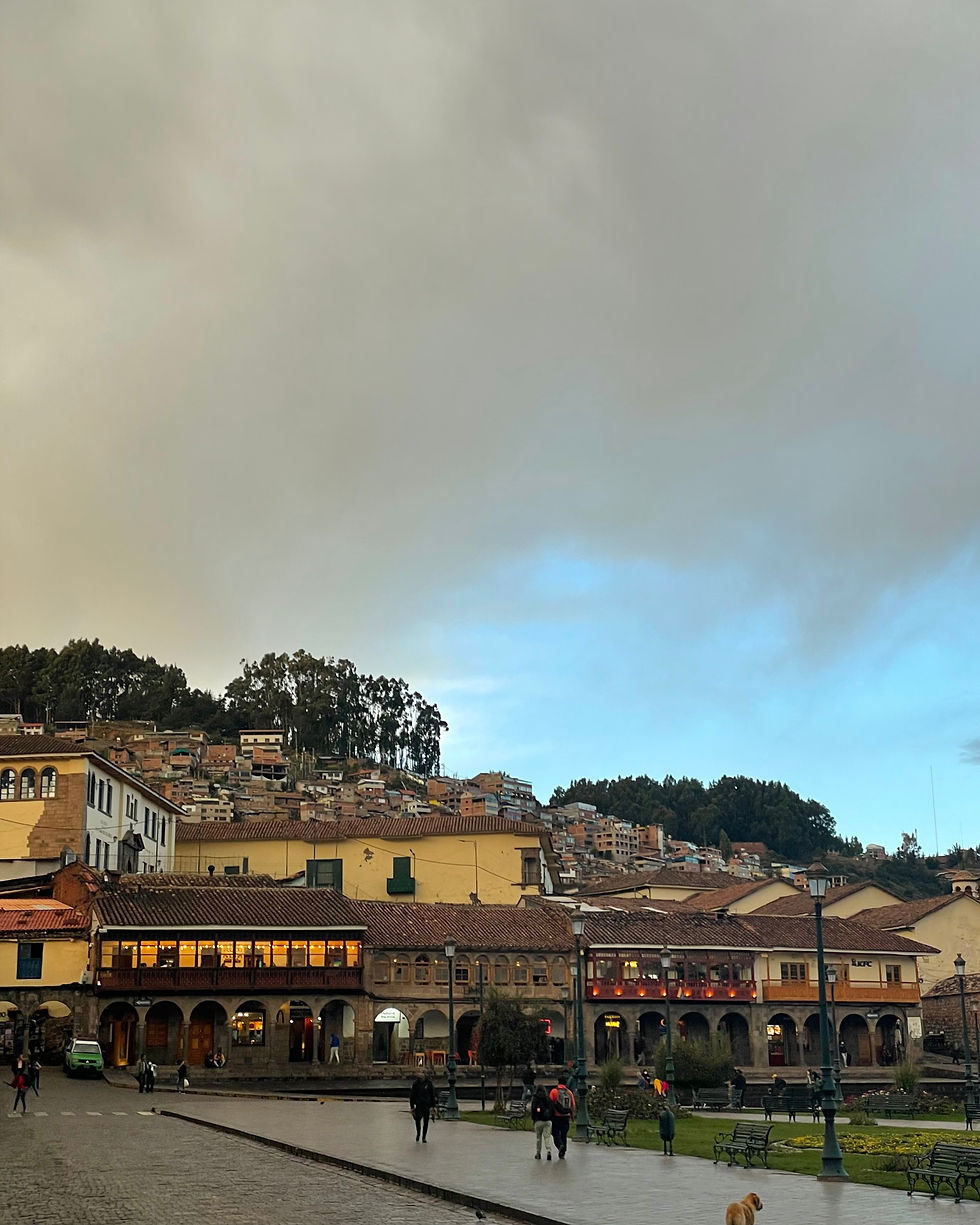
As I roamed through the streets, I couldn’t help but wonder what Cusco looked like before the cars, cafés, souvenir shops, and crowds of travelers. What was it like hundreds of years ago, when these same stone streets were walked by the people of the Inca Empire? I tried to imagine the city in its purest form—alive with markets, ceremonies, and everyday life long before the modern world arrived. After all, Cusco was the Capital of Inca Empire.
Standing there, it felt as though the past had never completely left. It was still woven into every wall, every alley, and every stone beneath my feet. Can you imagine if Memories of the Alhambra were playing in the background? It would have made the whole city feel even more magical. Well… my soundtrack was a little different. “¡Señorita, taxi?” or“Lady, you want this painting?” Those were the voices that followed me through Cusco’s winding cobblestone streets. At first, I smiled politely and shook my head. By the end of the trip, they had become part of the city’s soundtrack—phrases I can still hear whenever I think back to Cusco. Somehow, they became just as memorable as the breathtaking views and centuries-old architecture.


As the sun disappeared behind the mountains, tiny lights began to sparkle across the houses scattered along the hillsides, making the city feel even more enchanting. Eventually, I made my way back toward the hotel. By then, I was feeling a little dizzy and short of breath. I assumed I was simply hungry, so I stopped at a nearby restaurant for dinner before taking a Tylenol. Looking back, that probably wasn’t my smartest decision. I should have accepted the coca tea waiting for me at the hotel. But I’ll tell you why in tomorrow’s story.
Day One of the Salkantay Trek: The Magic of the Andes and the Battle With Altitude Sickness
Okay, I wasn’t being dramatic when I said it was a battle with altitude sickness.
It hit me within the first 15 minutes of starting the hike. Not slowly. Not gently. It came at me like a wrecking ball straight into my lungs. The lack of oxygen at this altitude made every step feel heavier, every breath feel shorter.
The funny thing is, the mountains were also taking my breath away—but in a completely different way. The view was so incredible that I kept stopping to admire it, while my body was desperately trying to remind me that breathing was still a priority. What? Did you hear the song Take My Breath Away playing in the background? Well, try hiking at high altitude with your lungs fighting for oxygen, and you’ll understand what it truly feels like to have your breath taken away. Just kidding… kind of.


I met Robin, our tour guide, the night before after dinner. He sat down with us and explained everything we needed to know about the trek—what we should pack in our day bags, what we should prepare for the horses to carry, and what to expect along the journey. Honestly, I couldn’t thank those horses enough. They carried our heavier bags and became the quiet heroes of this adventure. Without them, I’m not sure my legs would have survived the Andes.
I remember in the beginning, Robin told everyone in the group that this hike wasn’t about who reached the top first. It wasn’t a race. We were here to walk this journey together. “We are a team. We are a family.” Those words stayed with me because, as the days went on, I realized he wasn’t just saying it to motivate us. They truly built that feeling throughout the hike. We introduced ourselves to each other, shared stories, and slowly became more than just strangers walking the same trail. Although, I have to admit, my oxygen-deprived brain had other plans. Every time someone introduced themselves, their name would enter my mind for about three seconds before disappearing completely. So yes, I met my new teammates… but my altitude sickness brain definitely did not remember all their names at first.
As I mentioned earlier, the altitude sickness kicked in just 15 minutes after we started hiking. And honestly? It was brutal. It was completely my own fault, though. I hadn’t done any research beforehand. I’d completed a few multi-day hikes before, so I assumed I’d be fine. Altitude sickness never even crossed my mind. Some of my teammates had spent a week in Cusco before the trek, while others traveled overland from Lima, giving their bodies time to adjust to the elevation. Me? I started the hike less than 24 hours after landing in Cusco. Oops.
I felt awful because I was convinced I was slowing everyone down. But Robin, our guide, stayed beside me the whole time, sharing little remedies to ease the altitude sickness and encouraging me to keep going. Every now and then, one of my teammates would slow their pace just to check in on me. Not once did anyone make me feel like I was holding the group back. Most people had come with a friend, a sibling, or their partner. I was the only solo traveler in our group. That’s when I started chatting with Dan. He had come with his brother and his brother’s partner to hike to Machu Picchu before continuing on to the Amazon. At one point, he offered me one of his hiking poles.
Thanks again for that, mate. We finally reached our campsite at around one o’clock in the afternoon—not before I threw up everything I’d eaten. Yikes. Sorry… not sorry. It happened.
At that point, I genuinely thought I was going to die on that mountain. I was convinced I’d never make it to my first Wonder of the World, and I seriously considered retiring from hiking forever. Very dramatic, I know. But that’s exactly how I felt.

Lunch was served with one of the most breathtaking views I’d ever seen. A deep green valley stretched endlessly below us, while snow-capped mountains towered above.
Hello, Andes.
As the cool mountain air slowly settled my nausea, I sat there taking in the view, wondering if I’d ever have the courage to come back. I know, I know… I’m being dramatic again. But when your body feels like it’s betraying you, every thought becomes a little dramatic. After lunch, I retreated to my assigned hut. I had absolutely no intention of leaving it. It wasn’t exactly luxurious. There was no plush mattress or fluffy pillows—just a stone platform topped with a thin sleeping mat and my sleeping bag.
But the view? That was five-star. The roof was made entirely of glass, so from my sleeping bag I could look straight up at the magnificent Salkantay Mountain. Our campsite sat quietly in the valley, completely surrounded by the towering peaks of the Andes. Even while feeling absolutely miserable, I couldn’t deny that I had fallen asleep in one of the most beautiful places I’d ever been.


A Deck of Cards, A Valley of Dreams
After a nap and a little stroll around the campsite, some of my teammates decided to continue hiking to Laguna Humantay. As much as I wanted to join them, I was trying to be wise for once, so I stayed behind with Dan and challenged him to a game of Uno instead. It felt strangely magical—doing something as ordinary as playing Uno while surrounded by one of the most breathtaking landscapes I’d ever seen.
Later, we wandered around the valley, chatting with locals using Dan’s broken Spanish and my completely non-existent Spanish. Somehow, we still managed to communicate. We played with the local kids, laughed more than we spoke, and watched the sun slowly disappear behind the mountains. Honestly, the memories I made in the Salkantay Valley will stay with me forever. The friendships I made. The landscapes I witnessed. The lessons I learned. Would I willingly go through the pounding headache, the nausea, and the vomiting all over again? Absolutely. Because one day, when my knees complain louder than they do now and my feet can no longer carry me up these mountains, these are the memories I’ll return to. I’ll smile and say, “I did that.” Instead of, “I wish I had.”


Looking back, I’ve always been the kind of person who overthinks everything. I replay conversations before I have them, weigh every decision, and worry about making the wrong choice because I never want to live with regret.
Growing up in my small hometown in Indonesia, I used to lie awake at night wondering if I’d ever make it to the other side of the world. My hometown wasn’t exactly a place where international travel felt like a realistic dream. It was quiet, simple, and a world away from the adventures I imagined. Sometimes I’d wonder if I could really survive outside the little bubble I had always known. Life has a funny way of answering questions you never thought it would. Looking back now, I’m grateful I grew up there. It shaped the person I am today and made me appreciate every opportunity to explore places I once only dreamed about.

Well, well, well… This blog turned out much longer than I expected.But then again, the journey to Machu Picchu was even longer. So I’d love for you to keep walking with me and continue seeing Peru through my eyes. In the next chapter, we’ll head deeper into the Andes and find out who wins this rather one-sided battle between me and altitude sickness.
Every unforgettable journey has a beginning. Before the mountains tested my limits and the Andes took my breath away, there was Cusco—the city that captured my heart from the moment I arrived.

Comments